




Truck Accident Lawyer Chicago, IL
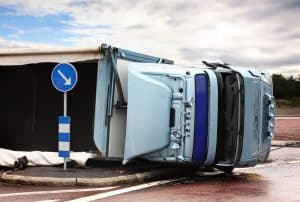 If you or someone you love was hit by a commercial truck in Chicago, the injuries may be severe. Survivors face shattered bones, traumatic brain injuries, spinal cord damage, and burns that require years of treatment.
Truck accident cases are not like ordinary car crashes. Multiple parties share potential liability like the driver, the trucking company, cargo loaders, maintenance providers, and sometimes vehicle manufacturers. Federal regulations govern hours of service, inspection requirements, and driver qualifications. Evidence disappears quickly when black box data gets overwritten and logbooks go missing. Disparti Law Group Accident & Injury Lawyers handles these complex claims throughout Chicago and Cook County. Larry Disparti built this firm to fight powerful defendants on behalf of injured people, and trucking companies with corporate legal teams don’t intimidate us. If you need a Chicago, IL truck accident lawyer, call us for a free consultation.
Why Choose Disparti Law Group Accident & Injury Lawyers for Truck Accident Cases in Chicago, IL?
Trucking companies and their insurers respond to serious accidents with overwhelming resources. They dispatch rapid response teams to accident scenes within hours. They download electronic logging data before it can be preserved independently. They take recorded statements from witnesses while memories are fresh and victims are medicated. Going against these defendants requires a firm with experience, resources, and willingness to fight through trial if necessary.
A Founder Who Takes On Powerful Defendants
Larry Disparti started Disparti Law Group Accident & Injury Lawyers in Chicago with a simple mission: hold negligent parties accountable regardless of how many lawyers they can afford. He serves on the Board of Managers for the Illinois Trial Lawyers Association and co-chairs ITLA’s Civil Practice & Rules Committee. These roles reflect his commitment to plaintiff advocacy at the highest levels of the profession.
Larry completed his undergraduate studies at the University of South Florida before earning his law degree from Stetson University College of Law. He maintains bar licenses in Illinois, Florida, Arizona, and Washington D.C. His memberships include the National Employment Lawyers Association, the Illinois Workers Compensation Lawyers Association, and the Justinian Society.
Larry Disparti has earned membership in the Million Dollar Advocates Forum and Multi-Million Dollar Advocates Forum. These organizations limit membership to attorneys who have secured verdicts or settlements exceeding one million dollars. Leading Lawyers recognizes him among the Top 10 Plaintiff Lawyers in Illinois, and the National Trial Lawyers Association includes him in their Top 100.
When families need a personal injury attorney in Chicago, IL to take on a trucking company, our firm brings the firepower these cases demand.
Exposed: Verdicts and Settlements That Prove Our Commitment
Disparti Law Group Accident & Injury Lawyers has secured millions of dollars for clients harmed by negligence. Our results include a $9.0 million verdict for a worker injured by equipment failure, a $6.6 million verdict for a transit employee hurt in a train derailment, and an $800,000 settlement after a dump truck struck five motorcyclists in Tennessee. These outcomes required taking on well-funded corporate defendants and demonstrating willingness to go to trial when settlement offers fell short.
No Money Down, Period
Truck accident victims shouldn’t deplete savings to hire attorneys while facing catastrophic medical bills. We handle these cases on contingency. You pay nothing upfront. We advance costs for accident reconstruction experts, medical specialists, and litigation expenses. If we don’t recover compensation, you owe us nothing. This structure lets us invest fully in building the strongest possible case without adding financial strain to families already dealing with devastating injuries.
Real Feedback From Real Clients
⭐⭐⭐⭐⭐
“Appreciate all the help the lawyer did for me I will recommend them to anyone Thanks for all your help” — Charles Usherb
Read more reviews on our Google Business Profile.

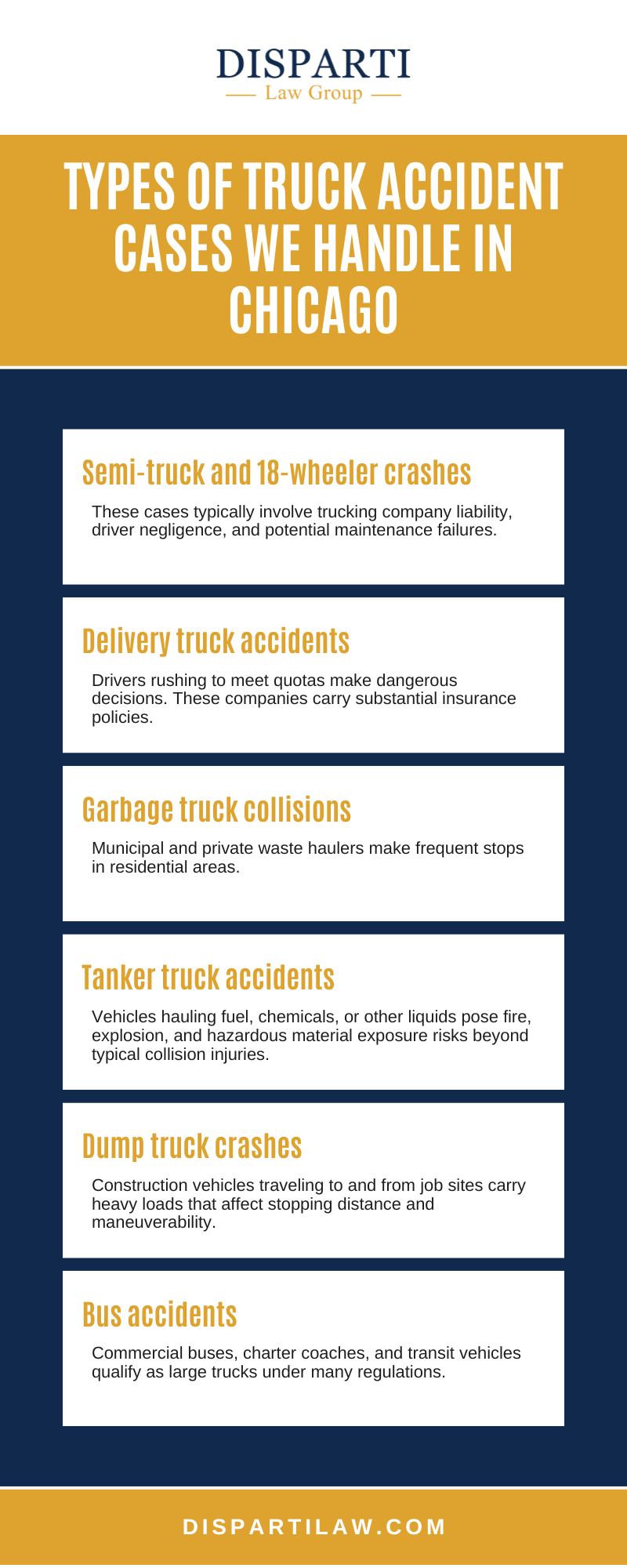
Types of Truck Accident Cases We Handle in Chicago
Commercial trucks come in many configurations, and each type of collision presents unique liability and damage issues. We represent victims in cases involving:
- Semi-truck and 18-wheeler crashes. The largest vehicles on the road cause the most catastrophic injuries. Tractor-trailers weighing up to 80,000 pounds fully loaded destroy passenger cars on impact. These cases typically involve trucking company liability, driver negligence, and potential maintenance failures.
- Delivery truck accidents. FedEx, UPS, Amazon, and local delivery vehicles operate under constant time pressure. Drivers rushing to meet quotas make dangerous decisions. These companies carry substantial insurance policies.
- Garbage truck collisions. Municipal and private waste haulers make frequent stops in residential areas. Their size, limited visibility, and stop-and-go operation create collision risks for other motorists, pedestrians, and cyclists.
- Tanker truck accidents. Vehicles hauling fuel, chemicals, or other liquids pose fire, explosion, and hazardous material exposure risks beyond typical collision injuries. These crashes often require evacuation and specialized cleanup.
- Dump truck crashes. Construction vehicles traveling to and from job sites carry heavy loads that affect stopping distance and maneuverability. Improperly secured loads can spill onto roadways.
- Bus accidents. Commercial buses, charter coaches, and transit vehicles qualify as large trucks under many regulations. Passenger injuries and third-party collision claims involve complex liability analysis.
- Overloaded and improperly loaded trucks. Cargo that exceeds weight limits or shifts during transport causes rollovers and loss-of-control crashes. Liability may extend to shippers and cargo loaders.
- Wide load and oversized vehicle accidents. Trucks carrying oversized cargo require special permits and escort vehicles. Violations of transport requirements create liability when crashes occur.
We investigate each accident thoroughly to identify all responsible parties and all applicable insurance coverage.
Illinois Legal Requirements for Truck Accident Claims

Federal and state regulations create standards that trucking companies and drivers must follow. Violations of these requirements support negligence claims when accidents occur.
Federal Motor Carrier Safety Regulations
The Federal Motor Carrier Safety Administration establishes rules governing commercial trucking nationwide. These regulations address hours of service limits that prevent fatigued driving, mandatory rest periods between shifts, vehicle inspection and maintenance requirements, driver qualification standards including medical certification, drug and alcohol testing protocols, and electronic logging device mandates. When trucking companies or drivers violate FMCSA regulations and cause accidents, those violations constitute strong evidence of negligence.
Illinois Commercial Vehicle Requirements
Illinois law imposes additional requirements on commercial vehicles operating within the state. The Illinois Vehicle Code addresses weight limits, equipment standards, and operating restrictions. The Illinois Commerce Commission regulates intrastate carriers. Violations of state requirements, combined with federal regulation breaches, strengthen liability claims.
Statute of Limitations
Under 735 ILCS 5/13-202, personal injury lawsuits in Illinois generally must be filed within two years of the accident. Truck accident cases often require extensive investigation, so beginning that process promptly matters. Waiting too long allows critical evidence to disappear.
Comparative Negligence
Illinois applies modified comparative negligence under 735 ILCS 5/2-1116. Recovery is reduced by your percentage of fault, and you cannot recover if you bear more than 50% responsibility. Trucking companies aggressively argue that passenger vehicle drivers caused or contributed to collisions. Strong evidence and skilled advocacy counter these tactics.
What Damages Are Recoverable in Chicago Truck Accident Cases?
Truck accident injuries produce damages that dwarf typical car crash claims. The severity of injuries and long-term impacts justify substantial compensation across multiple categories.
Economic Damages
Medical expenses in truck accident cases often reach six or seven figures. Emergency trauma care, surgeries, extended hospitalization, intensive care, rehabilitation facilities, physical therapy, occupational therapy, prescription medications, medical equipment, and home healthcare add up quickly. Many victims require lifetime medical care for permanent injuries. Future medical costs must be calculated and included in claims.
Lost income encompasses wages missed during recovery and extends far beyond. Truck accidents frequently cause injuries that prevent return to previous employment. A warehouse worker with a spinal cord injury cannot lift. An office employee with traumatic brain injury cannot concentrate. Calculating lifetime lost earning capacity requires vocational experts and economic analysis.
Property damage covers vehicle replacement or repair. Truck collisions typically total passenger vehicles entirely. Personal property inside the vehicle also qualifies for compensation.
Out-of-pocket expenses include transportation for medical appointments, home modifications for wheelchair access, hiring help for household tasks, and countless other costs that accumulate over months and years of recovery.
Non-Economic Damages
Pain and suffering in truck accident cases reflects the magnitude of injuries. Crushing trauma, burn injuries, amputations, and prolonged surgical recovery cause suffering that deserves substantial compensation. Chronic pain that persists for years affects every aspect of life.
Emotional distress encompasses PTSD, anxiety, depression, sleep disorders, and fear of driving. Truck accident survivors frequently develop lasting psychological trauma from the violence of these collisions.
Loss of enjoyment of life compensates when injuries prevent activities that gave life meaning. Unable to play with children. Unable to pursue hobbies. Unable to live independently.
Loss of consortium provides compensation to spouses and family members for impacts on relationships and family life.
Punitive Damages
When trucking companies or drivers act with willful disregard for safety through falsifying logbooks, forcing drivers to exceed hours limits, or ignoring known mechanical defects, punitive damages may be available. These awards punish egregious conduct and deter similar behavior throughout the industry.
What Steps Should I Take After a Truck Accident in Chicago?
The hours and days following a truck accident are critical for both medical recovery and legal claims. Take these steps if physically able:
1. Prioritize medical attention. Truck accident injuries are often severe. Accept emergency medical transport. Internal injuries, traumatic brain injury, and spinal damage require immediate treatment and may not produce obvious symptoms initially.
2. Call 911 immediately. Police response to truck accidents is essential. Officers document the scene, interview witnesses, and note violations. The official crash report becomes crucial evidence. Illinois law requires reporting accidents involving injury or significant property damage.
3. Document everything possible. If your injuries allow, photograph the scene extensively. Capture the truck’s damage, your vehicle’s damage, skid marks, road conditions, traffic signals, the truck’s DOT numbers and company name, and any visible cargo issues. These details matter enormously.
4. Identify the trucking company. Commercial trucks display DOT numbers, company names, and MC numbers on their doors. This information identifies the carrier and allows investigation of their safety history, insurance coverage, and prior violations.
5. Collect witness information. Bystanders who saw the collision provide valuable testimony about what happened. Their observations about truck speed, lane changes, or traffic signal status may prove critical.
6. Preserve evidence. Keep damaged clothing and personal items. Don’t authorize vehicle disposal without consulting an attorney. The physical evidence from your car may reveal impact angles and forces that support your claim.
7. Do not give recorded statements. Trucking company insurers will contact you quickly, seeking recorded statements while you’re still recovering. You are not obligated to provide these. Anything you say will be analyzed for inconsistencies and used to minimize your claim.
8. Request your medical records. Comprehensive medical documentation links your injuries to the accident. Make sure all complaints, diagnoses, and treatment recommendations are properly recorded.
9. Keep detailed notes. Document your pain levels, limitations, missed activities, and emotional state daily. These contemporaneous records support non-economic damage claims.
10. Contact a Chicago truck accident attorney promptly. Trucking companies begin building their defense immediately. Evidence preservation letters, black box data downloads, and independent scene investigation need to happen quickly. Having experienced representation from the start protects your rights.
Chicago Truck Accident Statistics
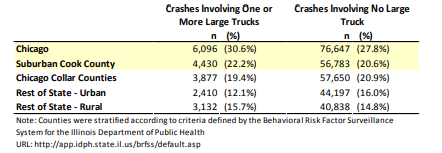
Truck Accident Statistics in Chicago
Chicago’s position as a major freight hub means commercial trucks constantly move through and around the city. That volume creates risk.
The Federal Motor Carrier Safety Administration reports that large trucks are involved in thousands of fatal crashes nationally each year. Illinois consistently ranks among the states with the highest numbers of truck accident fatalities due to its central location and extensive interstate system.
According to the National Highway Traffic Safety Administration, occupants of passenger vehicles account for the vast majority of deaths in crashes involving large trucks. The size and weight disparity makes these collisions devastating for everyone except the truck driver, who sits high above the impact zone in a reinforced cab.
Data from the Illinois Department of Transportation shows that Cook County sees more truck-involved crashes than any other county in the state. Interstate 90, Interstate 94, Interstate 290, and Interstate 55 all carry heavy truck traffic through the Chicago metropolitan area.
The Insurance Institute for Highway Safety notes that truck accident fatalities have increased significantly over the past decade even as passenger vehicle safety has improved. Contributing factors include driver shortages leading to undertrained operators, pressure to meet delivery deadlines, and inadequate enforcement of hours-of-service regulations.
Research published through the Government Accountability Office has documented ongoing concerns about trucking industry compliance with safety regulations. Violations of hours-of-service rules, inadequate vehicle maintenance, and driver qualification issues persist despite regulatory oversight.
Chicago Truck Accident Infographic
Chicago Truck Accident Lawyer FAQs
Who can be held liable for a truck accident?
Multiple parties may share responsibility. The truck driver bears liability for negligent operation. The trucking company may be liable under respondeat superior for employee actions or directly for negligent hiring, training, supervision, or maintenance. Cargo loaders bear responsibility for improperly secured loads. Maintenance providers may be liable for mechanical failures. Vehicle or parts manufacturers face liability for defective components. We investigate thoroughly to identify all responsible parties.
How are truck accidents different from car accidents?
Several factors distinguish these cases. Injury severity is typically far greater due to vehicle size disparity. Multiple liable parties create complex claims. Federal regulations establish standards that don’t apply to passenger vehicles. Trucking companies have sophisticated legal teams and rapid response protocols. Evidence including electronic logging data requires prompt preservation. Insurance policies are substantially larger, sometimes reaching millions of dollars.
What evidence is important in truck accident cases?
Critical evidence includes the truck’s electronic logging device data showing hours of service, the event data recorder capturing speed and braking before impact, driver qualification files, drug and alcohol testing results, vehicle inspection and maintenance records, dispatch communications showing schedule pressure, cargo loading documentation, and the trucking company’s safety history with FMCSA.
How quickly does evidence disappear in truck accident cases?
Alarmingly fast. Electronic logging device data may be overwritten within days or weeks. Trucking companies routinely repair or scrap damaged vehicles. Driver memories fade and witnesses become difficult to locate. Companies may reassign drivers or allow them to resign before depositions. Sending preservation letters immediately and conducting independent investigation protects against evidence spoliation, which is why taking strategic steps after a truck accident matters.
What are hours of service regulations?
Federal rules limit how long truck drivers can operate without rest. Generally, drivers cannot drive more than 11 hours after 10 consecutive hours off duty. They cannot drive after 14 hours on duty. They must take 30-minute breaks after 8 hours of driving. Weekly limits cap total driving time. Violations contribute to fatigued driving crashes.
Can I sue if the truck driver was an independent contractor?
Trucking companies sometimes classify drivers as independent contractors to avoid liability. However, courts look beyond labels to examine the actual relationship. If the company controlled the driver’s routes, schedules, and methods, employment relationship arguments remain viable. The company’s insurance coverage also typically extends to contracted drivers operating under their authority.
What if the trucking company’s insurance adjuster seems helpful?
Insurance adjusters work for the trucking company, not for you. Their goal is minimizing the company’s payout. Early helpfulness often aims to secure recorded statements or quick settlements before you understand your injuries’ full extent. Politely decline to discuss the accident until you have legal representation.
How long do truck accident cases take?
These cases typically take longer than car accident claims due to their complexity. Investigation, expert retention, discovery disputes, and potential litigation extend timelines. Cases may resolve anywhere from several months to several years depending on injury severity, liability disputes, and defendant cooperation. Some resolve through settlement; others require trial.
What compensation can I expect?
Truck accident compensation varies enormously based on injury severity, liability allocation, available insurance, and other factors. Minor injuries resolve for less than catastrophic ones. A full recovery with no permanent effects has different value than lifelong disability. We evaluate each case individually after reviewing medical records, understanding treatment prognosis, and identifying all available coverage.
Should I accept the trucking company’s settlement offer?
Almost never without attorney review. Early offers come before the full extent of injuries is known. Accepting prematurely forecloses future claims if your condition worsens or requires additional treatment. Knowing how insurance companies calculate settlement offers helps victims recognize when offers fall short of fair compensation.
What if I was partially at fault for the accident?
Illinois comparative negligence rules allow recovery if you’re 50% or less at fault, reduced by your percentage of responsibility. Trucking companies aggressively argue victim fault to reduce payouts. We counter these arguments with evidence and expert analysis. Even shared fault doesn’t eliminate your right to compensation.
Do I need a lawyer for a truck accident claim?
Truck accident cases involve complexity that makes experienced representation essential. Federal regulations, multiple defendants, corporate legal teams, rapid evidence preservation needs, expert requirements, and substantial damages all factor in. The top causes of Chicago truck accidents require thorough investigation, and attempting to handle these claims without an attorney typically results in significantly lower compensation and missed opportunities.
What if a family member died in a truck accident?
Illinois wrongful death laws allow surviving family members to pursue claims when negligent truck drivers or trucking companies cause fatal crashes. These cases have specific requirements regarding who can file, what damages are recoverable, and applicable deadlines. Dealing with insurance companies in wrongful death claims requires experienced representation.
How do I pay for medical treatment while my case is pending?
Health insurance typically covers treatment initially, then seeks reimbursement from any settlement. Some medical providers work on liens, waiting for payment until your case resolves. The process of how medical bills get covered in accident cases involves coordination between multiple sources. In catastrophic injury cases, we help coordinate care to ensure treatment continues regardless of case timing.
What makes a trucking company directly liable?
Companies face direct liability for negligent hiring of unqualified drivers, inadequate training, failure to properly supervise, pressure to violate hours-of-service rules, inadequate vehicle maintenance, and ignoring known safety problems. These claims go beyond driver negligence to target the company’s own wrongdoing.
Most Dangerous Locations for Truck Accidents in Chicago
Commercial truck traffic concentrates on certain corridors, creating elevated accident risk:
Interstate 94 (Dan Ryan/Kennedy Expressway). One of the nation’s busiest freight corridors, I-94 carries constant truck traffic through Chicago. Congestion, construction zones, and merging traffic create collision opportunities throughout its length.
Interstate 90 (Jane Byrne Interchange). The Circle Interchange where multiple expressways converge sees heavy truck traffic navigating complex lane changes and merges. Truck accidents here snarl traffic for miles.
Interstate 55 (Stevenson Expressway). Connecting Chicago to major distribution centers, I-55 carries heavy truck volume. The corridor south of the city sees particularly concentrated commercial vehicle traffic.
Interstate 290 (Eisenhower Expressway). East-west truck traffic through the city uses I-290, mixing with commuter vehicles in lanes that often lack adequate width for side-by-side truck travel.
Interstate 80. South of the city, I-80 serves as a major transcontinental freight route. Truck stops, distribution centers, and intermodal facilities along this corridor generate constant truck activity.
Cicero Avenue and other arterials. Surface streets connecting industrial areas to expressways see commercial vehicle traffic mixed with local traffic, creating conflict points at intersections and driveways.
O’Hare Airport vicinity. Freight operations around O’Hare generate truck traffic on surrounding roads at all hours.
What Are Important Local Resources for Truck Accident Victims in Chicago?
The following resources may assist truck accident victims in Chicago. Disparti Law Group Accident & Injury Lawyers does not endorse these organizations and provides this information for convenience only.
Chicago Police Department — (312) 746-6000
Illinois State Police — (847) 294-4400
Northwestern Memorial Hospital — (312) 926-2000
Loyola University Medical Center — (708) 216-9000
Federal Motor Carrier Safety Administration — (800) 832-5660
The Disparti Law Group Accident & Injury Lawyers, Chicago Truck Accident Lawyer
121 W Wacker Drive, Suite 2300, Chicago, IL 60601
Contact Disparti Law Group Accident & Injury Lawyers
Truck accidents change lives in an instant. When a massive commercial vehicle causes catastrophic injuries, victims need attorneys who will take on trucking companies and their insurers without hesitation. Disparti Law Group Accident & Injury Lawyers has the resources and determination these cases require.
We offer free consultations with no obligation. There are no fees unless we recover compensation for your injuries. We’ll evaluate what happened, explain your legal options, and give you honest answers about your case.
Contact our Chicago office to schedule a consultation with a Chicago, IL truck accident attorney ready to fight for the compensation you deserve.