




At Disparti Law Group Accident & Injury Lawyers, we are plaintiff-focused rideshare accident lawyers who have pursued full recovery for injured clients across Chicago for over 20 years.
If you were hurt in an Uber or Lyft crash, you may have questions about who pays, which policy applies, and what a claim is actually worth. Rideshare cases depend on rules that an ordinary two-car collision never brings up. Our Chicago, IL rideshare accident lawyer has handled these claims for passengers, drivers, and people struck by a rideshare vehicle. We represent injured people, not the companies insuring them. If someone else’s negligence caused your injuries, contact our office and we can walk you through the options.
Rideshare Accident Lawyer Chicago, IL
A rideshare accident claim is a personal injury case arising from a crash that involves a car working through an app like Uber or Lyft. In Chicago, these companies operate as licensed Transportation Network Providers, and city rules require them to run background checks, inspect vehicles, and carry insurance on affiliated drivers. That coverage is the reason a rideshare claim behaves so differently from a standard fender bender.
How much coverage applies turns on the driver’s status at the moment of the wreck. When the app is off, only the driver’s personal auto policy is in play. When the driver is signed on and waiting for a request, a limited company policy applies. Once a ride is accepted or a passenger is aboard, a much larger commercial policy takes effect. A Chicago rideshare accident attorney reads those phases correctly so the right insurer answers for the harm.

Types of Rideshare Accident Cases We Handle in Chicago
Rideshare crashes injure more than just passengers, and the right defendant is not always obvious. We take claims tied to both major platforms and to every position a person can occupy on the road. The categories below reflect the matters that come through our office most often.
- Uber accidents. Uber’s insurance coverage changes depending on what the driver was doing when the crash happened, so the exact moment recorded in the trip log often decides how much coverage is available. We pull that record early and press the correct policy rather than the smallest one an adjuster offers.
- Lyft accidents. Lyft’s coverage mirrors Uber’s in structure but differs in the details. We examine which phase governed the ride and pursue the policy that fits, rather than the one an insurer would prefer to apply.
- Injured passengers. A rider in the back seat almost never shares blame, which tends to make liability straightforward. The complication is coverage, since money may come from the driver, the platform, or a third motorist. Riders unsure of the Uber crash steps can start by documenting the ride and the injuries, then let us determine which policy pays.
- Other motorists and their passengers. When a rideshare driver causes a collision, the people in the other vehicle have claims too. A driver struck by a rideshare car faces the same phase-based coverage questions a passenger does, and the steps after a crash look much the same. We identify every applicable policy before anyone agrees to a number.
- Pedestrian accidents. A driver distracted by the app can seriously injure someone in a crosswalk. These victims often reach the rideshare policy when the driver was logged on at the time.
- Bicycle accidents. Sudden pickups and passengers opening doors into bike lanes both put riders at risk. We pursue the platform’s coverage whenever the driver was working when the crash happened.
- Rideshare drivers. Drivers are injured as well, and their eligibility depends on whether they were carrying a passenger at the time. Because the driver requirements for these apps shape the analysis, we look closely at the driver’s status and contract.
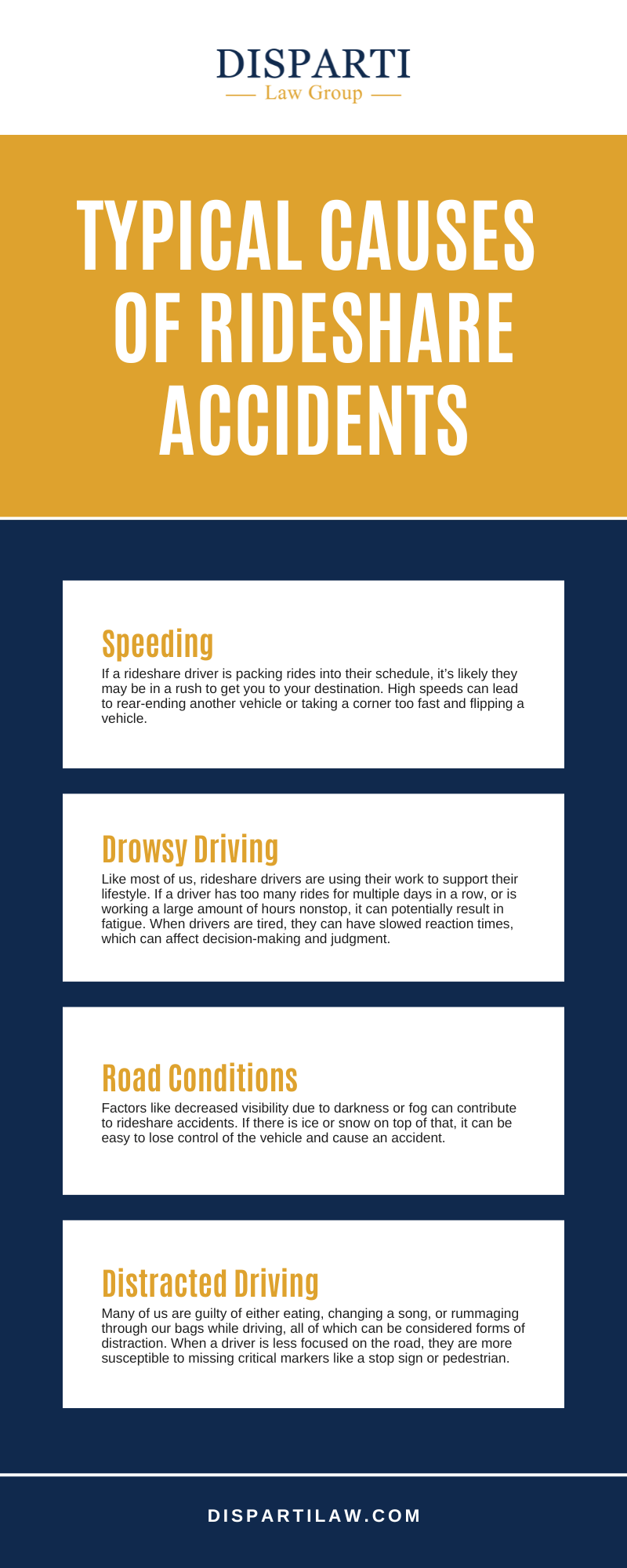
Chicago Rideshare Accident Infographic
Why Choose Disparti Law Group for Rideshare Accident Cases in Chicago, IL?
A Firm Built Around Injured Clients in Chicago
We have spent over two decades on the plaintiff’s side of auto and accident cases, and rideshare claims fit squarely within that work. Our founder, Larry Disparti, started the firm in 2004 and sits on the Board of Managers of the Illinois Trial Lawyers Association, an organization devoted to representing injured people. His law licenses span Illinois, Florida, Arizona, and Washington, D.C., and his national recognitions include the National Trial Lawyers Top 100 and membership in the Million Dollar Advocates Forum. Choosing our personal injury lawyer in Chicago, IL means partnering with a practice built for clients rather than carriers.
A Record of Results in Serious Injury Claims
Insurers move faster when they know a firm will try a case. Across our auto and accident practice, we have helped injured people recover millions of dollars, including several seven-figure results. We prepare each rideshare accident case for trial from the start, and that preparation is usually what convinces a company to pay what an injury is worth.
Understanding Rideshare Accident Cases
Damages, Liability, and Compensation for Rideshare Accident Cases
A rideshare crash is still a car accident claim at its core, so Illinois permits recovery for the range of losses a crash produces, which commonly include:
- Medical bills, both current and expected
- Lost income and reduced earning ability
- Pain and suffering
- Vehicle and property damage
- Loss of a normal life
Some of these losses have a readily calculable value, such as medical bills and lost wages. Others, such as ongoing pain, are more difficult to quantify, yet they remain fully compensable under Illinois law. Liability rests on negligence, meaning a failure to use reasonable care behind the wheel. Illinois also applies modified comparative negligence, so a recovery drops by the injured person’s share of fault and disappears entirely once that share passes fifty percent. Because even a small percentage of assigned fault can reduce a recovery, we move quickly to document how the crash unfolded, from the position of the vehicles to the driver’s app activity. Establishing fault accurately is often as important as proving the injuries. Crashes are common enough that the stakes are real; the CDC crash injury data counts more than 2.8 million emergency visits for motor vehicle crash injuries in a single recent year.
Important Aspects of a Rideshare Accident Case
A handful of features separate these claims from an ordinary crash, and handling them early tends to decide how the rest unfolds. The driver’s app status when the crash occurred is frequently the most significant fact in the case.
- The phase of the trip when the collision occurred
- The trip record, GPS data, and in-app messages
- Whether responsibility is split among multiple insurers
- How serious the injuries are and how well they are documented
When two or three carriers are involved, each has a reason to point at the others, and that finger-pointing can stall a claim unless someone forces the issue. These platforms log every ride in detail, and that data can pin down when a driver was on the clock. We act quickly to preserve it before it cycles out of the system.
Rideshare Accident Case Timeline
Every claim moves at its own pace, though most follow a familiar sequence. Serious injuries take longer, because we hold off on valuing a case until the medical picture settles.
- Treatment and investigation of how the crash happened
- Requesting the crash report, the app trip data, and each insurer’s information
- A demand presented to the responsible insurers
- Negotiation, and a lawsuit if the talks stall
- Settlement or trial
The length of the negotiation phase depends largely on how reasonably the insurer engages and on whether the injured person has finished treatment. Insurers sometimes stall while a deadline nears. Illinois gives injured people a limited window to file suit, so acting early protects both the evidence and the claim itself.
What to Bring to Your Rideshare Accident Consultation
A few documents help us evaluate a claim during the first meeting. Nothing formal is needed to get started.
- The trip receipt or ride history from the app
- The crash report number, if one was filed
- Photographs of the vehicles, the scene, and any visible injuries
- Insurance details for every driver involved
- Medical records or bills you already have
Expect a direct conversation about what happened and the options in front of you. We’ll explain how we see the claim, and how insurers value a settlement, before you commit to anything.
Illinois Legal Resources for Rideshare Accident Cases
These public resources help you confirm how Illinois treats the legal questions behind an injury claim. They are intended to help you locate the governing law and are not a substitute for advice about your specific situation.
- The Illinois Compiled Statutes set the general two-year deadline for filing a personal injury lawsuit.
- The state’s comparative negligence law explains how shared fault changes what an injured person recovers.
- The Illinois Courts self-help resources describe the civil court process and provide approved forms.
Reach Out to Disparti Law Group Accident & Injury Lawyers to Schedule a Consultation
If a rideshare crash left you hurt in Chicago, we can evaluate your case at no cost to you. Consultations are provided at no charge, and no attorney fee is owed unless we recover compensation on your behalf. We will review what happened, tell you candidly how the claim looks, and answer your questions. Contact us when you’re ready to begin.
Rideshare Accident Statistics in Chicago
 Most people hurt in a rideshare crash were sitting in the back seat. A rider has no control over the vehicle and no view of the driver’s phone. Passenger injury data therefore describes the rideshare risk more accurately than driver data does. The differences between rideshare and standard crashes start with who is sitting where.
Distraction is the other number worth knowing. A rideshare driver is working from a phone mounted on the dash, accepting requests and reading directions while moving through traffic. The federal distraction figures are not rideshare-specific, but they describe the behavior the app requires. A rideshare accident lawyer in Chicago, IL will look for evidence of that behavior in the trip log and in the phone records.
-
In IDOT’s 2024 crash report, passengers accounted for 20.3 percent of all incapacitating injuries in Illinois crashes.
-
Passengers also represented 17.7 percent of all Illinois crash fatalities in 2024, an increase of 4.5 percent over 2023, according to the same IDOT report.
-
IDOT estimated the total cost of Illinois crashes in 2024 at $8.3 billion, with each incapacitating injury valued at $171,925.
-
Nationally, NHTSA distracted driving data records 3,208 people killed in 2024 in crashes involving a distracted driver.
Factors That Affect the Outcome of Your Chicago Rideshare Accident Case
Two Chicago rideshare accident claims with similar injuries can end with very different results. The variables below account for most of that gap, and several of them are within your control in the first two weeks.
-
The driver’s status at the moment of impact. Whether the driver was offline, waiting for a request, or carrying a passenger determines which insurance policy responds and how much coverage is available. The trip log settles this question, and we request it before the platform’s retention period expires.
-
How many insurers are involved. A crash between a rideshare vehicle and a private car can put three carriers at the table. Each has a reason to argue that another should pay first. Claims stall when no one forces the sequence, so we present the demand to every carrier at once.
-
Whether your injuries were documented promptly. An emergency room visit on the day of the crash creates a record that ties the injury to the collision. Some injuries surface later, and a delayed first visit gives the adjuster an opening to attribute the symptoms to something else.
-
Pre-existing conditions. A prior back injury does not defeat a claim, but it changes how the claim must be proven. Insurers use pre-existing conditions to argue that the crash caused only a minor aggravation. Medical records from before the collision are the answer to that argument.
-
The fault percentage assigned to you. Passengers are rarely blamed, but other motorists struck by a rideshare vehicle often are. Illinois reduces a recovery by the injured person’s share of fault under the 51 percent rule, and a recovery is barred entirely when that share is more than 50 percent.
-
Arbitration language in the app’s terms of service. Riders who accepted the platform’s user agreement may have agreed to arbitrate certain disputes. That clause does not affect a claim against the driver’s insurer, but it can shape a claim against the company itself. A Chicago Lyft crash recently exposed the arbitration terms that riders never read.
-
Whether a lawsuit is filed. Insurers price a claim differently once a Chicago rideshare accident lawyer files a complaint in Cook County. Most rideshare cases settle, but the settlement value depends on the insurer believing the case will be tried if necessary.
-
What you said to the insurer. A recorded statement given in the first 48 hours is used against the claim months later. Politely decline until you have spoken with a Chicago rideshare accident attorney.
Chicago Rideshare Accident Lawyer FAQs
What does a rideshare accident attorney in Chicago charge?
We handle these claims on a contingency fee. The initial consultation is free, no retainer is required, and our fee comes out of the recovery rather than your pocket. If there is no recovery, you owe no attorney fee. The percentage is set out in a written agreement before any work begins.
Can I sue Uber or Lyft directly after a crash in Chicago?
Usually the claim proceeds against the insurance policy that covers the driver at the time of the crash, which may be a policy the platform provides. Whether the company itself can be named as a defendant depends on the facts of the crash and the terms the rider agreed to. The question of whether you can sue Uber directly comes up often and rarely has a one-word answer.
I was a passenger and another driver caused the crash. Who pays?
The at-fault driver’s liability insurer is the primary source of compensation. If that driver was uninsured or carried low limits, the rideshare platform’s uninsured and underinsured motorist coverage may apply because you were a passenger on an active trip. We pursue both sources in the order that produces the largest recovery.
Does the rideshare policy cover me if the driver was between rides?
A more limited policy applies when the driver was logged in and waiting for a request. Coverage is lower than during an active trip, and the driver’s personal insurer often argues that its policy excludes commercial activity. The rideshare coverage questions that arise in this phase are the reason the exact timestamp of the crash matters so much.
How long do I have to file a rideshare accident lawsuit in Chicago, IL?
Illinois gives an injured person two years from the crash date to file a personal injury lawsuit under 735 ILCS 5/13-202. That period is not the whole picture. A claim involving a government vehicle carries a shorter window, the deadline is tolled for minors, and a wrongful death claim is measured from the date of death rather than the date of the crash. The only dependable way to know which deadline governs your claim is to have it reviewed early.
Should I report the crash through the app?
Yes. The in-app report creates a timestamped record that the platform cannot later dispute, and it triggers the company’s own incident process. Keep the report factual. State where the crash occurred and that you were injured. Do not speculate about fault or describe your injuries as minor.
Do rideshare accident cases go to trial?
A small number do. Most resolve through negotiation once the insurers understand the medical evidence and the coverage picture. The reasons these claims often skip court have as much to do with arbitration terms and coverage structure as with the strength of the case. We prepare every claim as though it will be tried.
What if I was the rideshare driver?
Drivers injured by another motorist have a claim against that motorist’s insurer, and a rideshare accident lawyer in Chicago can pursue it on the same terms as a passenger claim. If the driver was carrying a passenger or en route to a pickup, the platform’s coverage may also apply.
Important Resources for Chicago Rideshare Accident Cases
Most Dangerous Locations for Rideshare Accidents in Chicago
Rideshare crashes cluster where pickups and drop-offs are dense. Airports, nightlife districts, and event venues produce the sudden stops and door-zone collisions that a Chicago rideshare accident lawyer sees most often.
Dangerous streets and pickup zones:
-
Clark Street at Addison Street. Post-game traffic outside Wrigley Field creates a wall of stopped vehicles and riders crossing mid-block.
-
Hubbard Street and Kinzie Street in River North. Late-night pickups in front of bars and clubs put rideshare vehicles in conflict with pedestrians and cyclists.
-
Lower Wacker Drive. Poor lighting and tight merges make this a frequent site of rear-end collisions involving drivers following turn-by-turn directions.
-
Michigan Avenue between the river and Oak Street. Curbside stops on the Magnificent Mile block bus lanes and bike lanes.
-
Madison Street near the United Center. Event-day congestion produces low-speed but high-volume collisions.
Dangerous highways and airport approaches:
-
Kennedy Expressway (I-90) and the I-190 spur into O’Hare. Drivers changing lanes for the terminal exits cause sideswipe crashes.
-
Stevenson Expressway (I-55) toward Midway. Heavy truck traffic combines with rideshare drivers exiting at Cicero Avenue.
-
DuSable Lake Shore Drive near Navy Pier and the Museum Campus. Weekend visitor traffic and abrupt braking at the exits.
What Are Important Local Resources for Chicago Rideshare Accidents?
Rideshare passengers frequently need to report a driver to the city and obtain trauma care in the same week.
-
Chicago Department of Business Affairs and Consumer Protection, 121 N. LaSalle Street, Room 805, (312) 744-6060. Investigates complaints against licensed rideshare operators filed through 311.
-
Northwestern Memorial Hospital Emergency Department, 251 E. Huron Street, (312) 926-2000. Level I trauma center in Streeterville, close to the River North and Magnificent Mile pickup zones.
Disparti Law Group does not endorse these organizations and receives no compensation for listing them. The information is provided for reference only.
About Disparti Law Group
Larry Disparti earned his law degree at Stetson University College of Law and belongs to the Presidents Club of the City Club of Chicago and the Justinian Society. More than 30 attorneys practice at Disparti Law Group across personal injury, employment, disability, and workers’ compensation matters. Results in vehicle collision cases include the following.
-
$2,500,000 for a client injured in a rear-end collision.
-
$460,000 for a client hurt in a T-bone collision at an intersection.
-
$195,000 for a client injured in a five-mile-per-hour crash after the insurer’s initial offer of $700.
What Our Clients Say
★★★★★
“Disparti Law Group is amazing!! They are all very professional and informative while helping through a difficult time. I would highly recommend them to all my friends and family…” — Shannon Dolan
Read more reviews on our Google Business Profile.
Additional Resources for Chicago Rideshare Accident Cases
Contact Disparti Law Group
A rideshare crash leaves you dealing with two or three insurance companies at once, and none of them works for you. Our rideshare accident attorneys in Chicago, IL sort out which policy applies and pursue the coverage you are owed. The consultation is free, and we take these cases on contingency. Bring the trip receipt and whatever records you have. We will tell you where the claim stands. We answer calls around the clock. Contact us to get started.