




Lyft Accident Lawyer Chicago, IL
If you were hurt in an accident involving a Lyft vehicle, sorting out who pays for your injuries is far more complicated than a typical car crash. Maybe you were a passenger and the driver ran a red light. Maybe you were in another car and a Lyft driver sideswiped you while checking the app. Maybe you were crossing the street and got hit by someone rushing to pick up their next fare. Whatever happened, you’re now dealing with medical bills, missed work, and pain that disrupts your daily life.
Disparti Law Group Accident & Injury Lawyers handles Lyft accident cases throughout Chicago and knows how to cut through the corporate layers to get injured people compensated. Larry Disparti built this firm to take on companies that hide behind complexity, and Lyft’s insurance maze doesn’t intimidate us. If you need a Chicago, IL Lyft accident lawyer, we offer free consultations to accident victims trying to figure out their next steps.
Why Choose Disparti Law Group Accident & Injury Lawyers for Lyft Accident Cases in Chicago, IL?
Lyft doesn’t make claims easy. Their insurance structure shifts depending on what the driver was doing at the moment of the crash. Their corporate lawyers know every argument for why some other policy should pay instead of theirs. Adjusters from multiple insurance companies point fingers at each other while you wait for someone to cover your medical bills. You need representation that can force accountability from a company designed to avoid it.
A Founder Who Takes On Corporate Defendants
Larry Disparti founded Disparti Law Group Accident & Injury Lawyers in Chicago because injured people deserve attorneys who won’t be outmaneuvered by corporate legal teams. He serves on the Board of Managers for the Illinois Trial Lawyers Association and co-chairs ITLA’s Civil Practice & Rules Committee. These roles reflect his commitment to plaintiff advocacy against well-resourced defendants.
Larry completed his undergraduate education at the University of South Florida before earning his law degree from Stetson University College of Law. He maintains licenses in Illinois, Florida, Arizona, and Washington D.C., and his memberships include the National Employment Lawyers Association, the Illinois Workers Compensation Lawyers Association, and the Justinian Society.
Larry Disparti holds membership in the Million Dollar Advocates Forum and Multi-Million Dollar Advocates Forum. These organizations only admit attorneys who have secured verdicts or settlements exceeding one million dollars. Leading Lawyers ranks him among the Top 10 Plaintiff Lawyers in Illinois, and the National Trial Lawyers Association includes him in their Top 100.
Families searching for a personal injury attorney in Chicago, IL to handle a rideshare claim will find that our firm has the experience and determination these cases require.
Results That Show What We Can Accomplish
Disparti Law Group Accident & Injury Lawyers has recovered millions of dollars for clients harmed by negligence. Our verdicts include $9.0 million for a worker injured by equipment failure, $6.6 million for a transit employee hurt in a derailment, and $136,200 for a truck driver after State Farm offered just $40,000. That last result matters because it shows we fight for fair compensation even when insurance companies think they can lowball injured people.
Your Case Costs You Nothing Upfront
Medical bills don’t wait for lawsuits to resolve. You’re missing paychecks while you recover. Adding attorney fees to your financial stress would make an already difficult situation worse. We handle Lyft accident cases on contingency, which means you pay nothing unless we recover compensation. We advance investigation costs, expert fees, and litigation expenses. If we don’t win, you don’t owe us a dime.
Clients Describe Their Experience With Us
⭐⭐⭐⭐⭐
“Very responsive and informative I would recommend this firm to anyone.” — Walter Hall
More client reviews appear on our Google Business Profile.
Types of Lyft Accident Cases We Handle in Chicago
Lyft accidents happen in various circumstances, and each scenario raises different insurance and liability questions. We represent people injured in:
-
Crashes while riding as a Lyft passenger. You requested a ride, got in the car, and the driver caused or was involved in an accident that injured you. Lyft’s $1 million commercial policy should apply here, but getting the company to pay fairly is another matter entirely.
-
Collisions caused by Lyft drivers when you’re in another vehicle. A Lyft driver rear-ended you at a stoplight or changed lanes into your car while distracted by the app. Which insurance responds depends on whether they had a passenger, were en route to pick someone up, or were just waiting for a ride request.
-
Pedestrian accidents. You were crossing the street legally when a Lyft driver hit you. Pedestrians suffer severe injuries because they have no protection from vehicle impact, and Lyft’s insurance situation adds complexity to already devastating crashes.
-
Bicycle accidents. Cyclists face constant danger from distracted drivers, and rideshare drivers checking phones for ride requests or navigation create particular risks. Dooring accidents happen when Lyft passengers exit without checking for bikes.
-
Accidents where Lyft driver’s negligence is disputed. Maybe the Lyft driver claims the other car caused the crash. Maybe both drivers share fault. Sorting out liability affects which insurance pays and how much you can recover.
-
Lyft accidents involving multiple vehicles. Chain-reaction crashes create multiple potential defendants and insurance policies. These cases require careful analysis of who did what and which coverage applies.
-
Accidents caused by vehicle defects. Sometimes crashes result from mechanical failures rather than driver error. If a defective vehicle or part contributed to your accident, manufacturers may share liability alongside the driver and Lyft’s insurance.
Each situation requires analyzing the specific facts to identify all responsible parties and all available insurance coverage.
Illinois Legal Requirements for Lyft Accident Claims
Illinois law establishes specific rules governing rideshare operations and the claims that arise when accidents occur.
Transportation Network Provider Regulations
The Transportation Network Providers Act governs how companies like Lyft operate in Illinois and mandates minimum insurance coverage that changes based on what the driver is doing at the time of an accident. When a driver has the app on but hasn’t accepted a ride, Lyft must provide limited liability coverage of $50,000 per person and $100,000 per accident. Once the driver accepts a ride request, coverage jumps to $1 million and stays there through passenger dropoff. Insurance companies fight aggressively over which coverage period applies because the difference between $50,000 and $1 million is enormous. A few seconds of timing can determine your entire claim’s value.
Statute of Limitations
Under 735 ILCS 5/13-202, you generally have two years from the accident date to file a personal injury lawsuit in Illinois. Lyft accident cases often require substantial investigation to determine which insurance applies and who bears liability, so starting that process early matters. Waiting until the deadline approaches risks losing your right to compensation entirely.
Comparative Negligence
Illinois follows modified comparative negligence under 735 ILCS 5/2-1116. Your compensation gets reduced by whatever percentage of fault you bear, and you recover nothing if you’re more than 50% responsible. Lyft’s insurance adjusters look for any argument that you contributed to the crash because shifting even partial blame to you reduces what they pay.
Uninsured Motorist Coverage Requirements
The Illinois Insurance Code requires Lyft to provide uninsured and underinsured motorist coverage when drivers are en route to passengers or have passengers in the vehicle. This protection matters when another driver causes your accident but lacks adequate insurance. During the waiting-for-request period, Lyft’s uninsured motorist coverage is more limited, and your own auto policy may need to fill gaps.
What Damages Are Recoverable in a Chicago Lyft Accident Case?
Lyft accident victims can pursue compensation for all harms caused by the crash, including both financial losses and non-economic impacts.
Economic Damages
Medical expenses cover everything from ambulance rides and emergency rooms to surgeries, hospital stays, physical therapy, medications, and ongoing treatment. Future medical costs matter too if your injuries require continued care. Lyft accidents frequently cause whiplash, back injuries, broken bones, head trauma, and other conditions requiring substantial treatment.
Lost wages compensate for income you miss while recovering. If your injuries prevent returning to your previous job or limit your earning capacity going forward, future lost income becomes part of your claim.
Property damage pays to repair or replace your vehicle and personal belongings damaged in the crash.
Out-of-pocket expenses include transportation to medical appointments, help with household tasks you can’t perform, childcare during recovery, and countless other costs that add up over weeks and months of healing.
Non-Economic Damages
Pain and suffering addresses the physical discomfort you endure during treatment and beyond. Car accidents cause injuries that hurt, and that pain deserves compensation even though it can’t be easily measured.
Emotional distress covers anxiety, depression, PTSD, fear of driving, and other psychological impacts that accidents cause. Some people develop lasting trauma from crashes that affects their lives long after physical wounds heal.
Loss of enjoyment of life compensates when injuries prevent activities you valued. Unable to exercise. Can’t pick up your kids. Hobbies you loved are now impossible. These losses matter.
When Multiple Insurance Policies Apply
Lyft accidents sometimes involve coverage from multiple sources: Lyft’s commercial policy, the driver’s personal insurance, another driver’s insurance if they contributed to the crash, and possibly your own uninsured motorist coverage. Identifying all available coverage maximizes the compensation pool.
What Steps Should I Take After a Lyft Accident?
The steps you take immediately after a Lyft accident affect both your health and your legal claim.
1. Get medical attention. Your health comes first. Even if you feel okay initially, adrenaline can mask injuries. See a doctor promptly to document your condition and catch problems early.
2. Call 911 if police haven’t been contacted. A police report creates crucial documentation of what happened. Officers record driver information, witness statements, and their observations about the scene.
3. Screenshot the Lyft app. If you were a passenger, your phone shows the ride details, driver information, and trip status at the time of the crash. This evidence can prove what period the driver was in and what coverage applies. Screenshot everything before it disappears from your app history.
4. Document the scene if possible. Photos of vehicle damage, the accident location, traffic signals, skid marks, and road conditions all help reconstruct what happened. Capture the Lyft vehicle’s license plate and any visible rideshare identifiers.
5. Get contact information from everyone involved. Names, phone numbers, and insurance details for all drivers. Contact information for any witnesses. The Lyft driver’s name should match what appears in the app.
6. Report the accident to Lyft through their app. Lyft has a process for reporting accidents that creates an official record with the company. Follow their procedure while also documenting everything independently.
7. Don’t give recorded statements to insurance companies yet. Adjusters from Lyft’s insurer, the driver’s personal insurer, and other drivers’ insurers may all contact you seeking statements. Each is looking for ways to minimize their company’s responsibility. Politely decline until you’ve spoken with an attorney.
8. Keep records of everything. Medical visits, bills, prescriptions, days missed from work, how injuries affect your daily life. The more documentation you have, the stronger your claim.
9. Contact a Chicago Lyft accident attorney. Rideshare insurance issues create complexity that most accident victims aren’t equipped to navigate alone. Early consultation helps protect your rights and identify all available coverage.
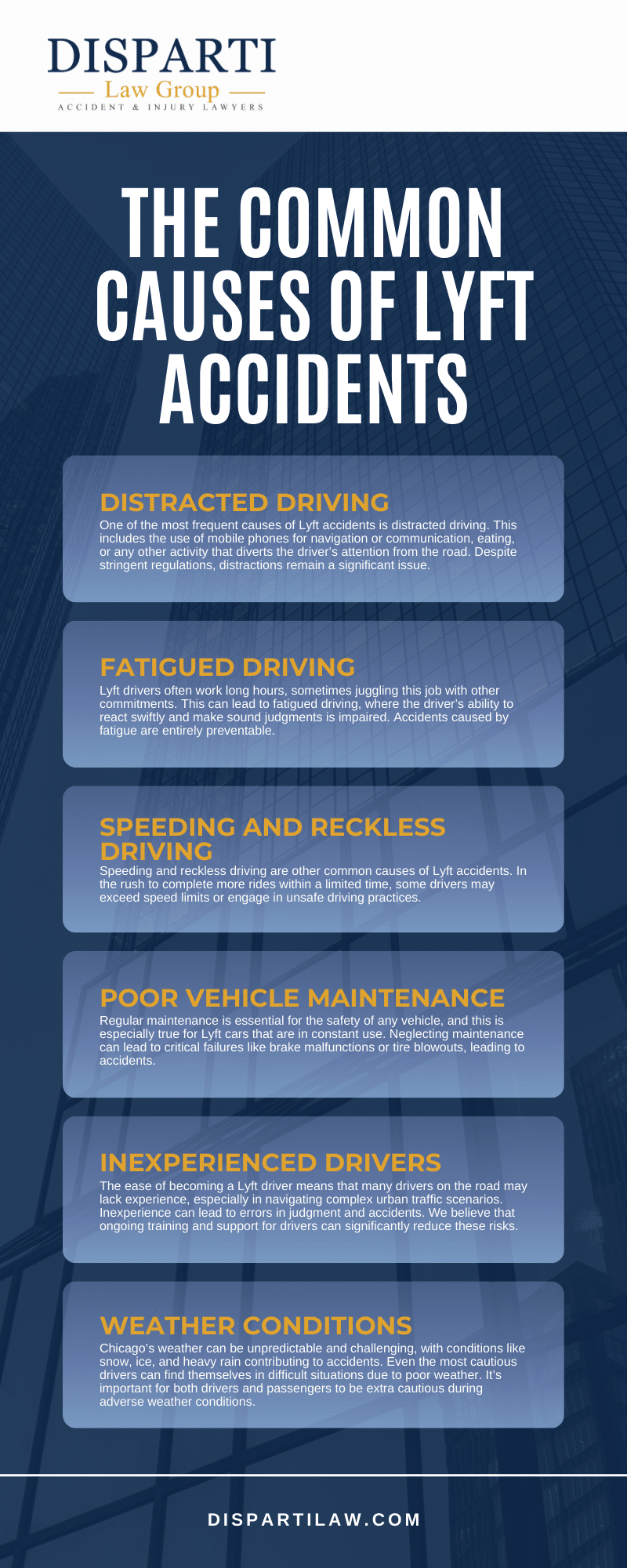
Lyft Accident Infographic
Lyft Accident Statistics in Chicago
Rideshare companies have transformed urban transportation, but the safety implications remain concerning.
According to data from the National Highway Traffic Safety Administration, traffic fatalities have increased significantly since rideshare services became widespread. While correlation doesn’t prove causation, research has linked rideshare growth to increases in accidents and fatalities in major metropolitan areas.
Studies cited by the Insurance Institute for Highway Safety found that rideshare services like Lyft correlate with increased traffic congestion, more vehicle miles traveled, and elevated accident rates in cities where they operate heavily. Chicago’s dense traffic and Lyft’s significant presence create substantial exposure.
The Illinois Department of Transportation tracks motor vehicle crashes statewide. Cook County consistently leads Illinois in traffic accidents, and rideshare vehicles contribute to that total. Exact rideshare-specific statistics remain difficult to isolate because crash reports don’t always identify rideshare involvement.
Research from the University of Chicago has examined rideshare impacts on traffic safety in Chicago specifically, finding measurable increases in accidents following rideshare expansion. Distracted driving as drivers monitor apps, pressure to accept rides and reach passengers quickly, and driver fatigue from long shifts all contribute to accident risk.
The Chicago Department of Transportation has implemented various regulations for rideshare vehicles, including vehicle inspection requirements and airport staging rules. Despite these efforts, Lyft accidents remain common throughout the city.
Chicago Lyft Accident Lawyer FAQs
Who pays for my injuries in a Lyft accident?
That depends on what the driver was doing when the crash happened and who caused it. If you were a passenger and the Lyft driver caused the crash, Lyft’s $1 million policy should apply. If another driver caused it, that driver’s insurance is primary, with Lyft’s uninsured/underinsured coverage as backup. If the driver was waiting for a request, coverage is much more limited. Sorting this out requires analyzing the specific facts, and rideshare vs standard car accident liability differs significantly.
What if I was the Lyft driver?
Lyft drivers have different rights and options than passengers or other motorists. Your personal insurance may or may not cover accidents during rideshare activity depending on your policy. Lyft provides some coverage, but it has gaps. If another driver caused the crash, you can pursue their insurance. These cases raise additional complexity around employment status and available benefits. Drivers who have been injured in a Lyft accident face unique challenges navigating multiple coverage sources.
How do I prove what the driver was doing when the accident happened?
App data, trip records, and phone data can establish whether the driver had the app on, had accepted a ride, or was transporting a passenger. Lyft has this information, and we can obtain it through legal discovery. Timestamps matter because a few seconds of difference can determine which coverage applies.
What if Lyft’s insurance denies my claim?
Insurance companies deny claims for many reasons, some legitimate and some not. They may argue the driver was in a lower coverage period, that another driver caused the accident, or that your injuries aren’t as serious as claimed. Denials aren’t final. We challenge improper denials and force insurers to honor their coverage obligations.
How much is my Lyft accident case worth?
Case value depends on injury severity, treatment costs, lost income, and how the accident affects your life going forward. Minor injuries with full recovery are worth less than permanent disabilities. How insurance companies calculate settlement offers affects the amounts they propose, and we evaluate each case individually based on the specific damages involved.
Will I have to sue Lyft directly?
Most Lyft accident claims are insurance claims against Lyft’s commercial policy rather than lawsuits against the company itself. However, litigation sometimes becomes necessary when insurers refuse to offer fair compensation. We’re prepared to file suit and take cases to trial when that’s what it takes to get results.
How long do Lyft accident cases take?
Timeline varies based on injury severity, coverage disputes, and whether litigation is required. Simpler cases with clear liability may resolve in months. Complex cases involving disputed coverage or serious injuries can take a year or longer. We work to resolve cases efficiently while not accepting inadequate settlements just to finish quickly.
What if the other driver was uninsured?
Lyft’s uninsured motorist coverage applies during Periods 2 and 3 if another uninsured driver caused your accident. This coverage can pay your claim when the at-fault driver lacks insurance. During Period 1, coverage is more limited, and your own uninsured motorist policy may need to respond.
Can I still file a claim if I wasn’t wearing a seatbelt?
Yes, though Illinois law may reduce your compensation. Failure to wear a seatbelt can be used as evidence of comparative negligence. However, the driver who caused the accident remains liable for the crash itself, even if your injuries would have been less severe with a seatbelt.
What if I’m partially at fault for the accident?
Illinois comparative negligence rules reduce your recovery by your percentage of fault but don’t eliminate it unless you’re more than 50% responsible. Insurance companies routinely argue that victims contributed to their accidents. We counter these arguments with evidence and analysis.
Should I accept Lyft’s settlement offer?
Early settlement offers rarely reflect the full value of claims. Insurance companies offer quick settlements hoping victims will accept before understanding their injuries’ full extent. Have an attorney review any offer before accepting. Once you settle, you cannot pursue additional compensation later. What to do after a Lyft accident includes getting legal guidance before accepting any offer.
Do I need a lawyer for a Lyft accident claim?
Rideshare accidents involve insurance complexity that doesn’t exist in typical car crashes. Multiple policies, coverage period disputes, and corporate defendants who know how to minimize payouts create challenges that most accident victims can’t navigate effectively alone. How medical bills get covered in rideshare accident cases adds another layer of complexity, and experienced representation typically increases net recovery even after attorney fees.
What makes Disparti Law Group Accident & Injury Lawyers effective in Lyft cases?
We understand how Lyft’s insurance structure works and how to force them to provide coverage they’d rather avoid. Larry Disparti built this firm to take on corporate defendants, and rideshare companies hiding behind complex insurance arrangements are exactly the kind of opponent we know how to fight. Social media can affect your car accident claim in ways most people don’t anticipate, and we guide clients through every aspect of these cases to maximize recovery.
Most Dangerous Locations for Lyft Accidents in Chicago
Certain areas see concentrated rideshare activity and elevated accident risk:
O’Hare and Midway airports. Rideshare staging areas, passenger pickup zones, and the rush to reach arriving travelers create congestion and collision opportunities. Airport trips make up a significant portion of Lyft rides in Chicago.
Downtown Loop. Dense traffic, pedestrians everywhere, one-way streets, and constant rideshare pickups and dropoffs create challenging conditions. Lyft drivers stopping suddenly to pick up passengers cause rear-end collisions regularly.
Wrigleyville and Lakeview on event nights. Cubs games and concerts flood these neighborhoods with rideshare vehicles. Drunk passengers, double-parked cars, and congested streets increase accident risk dramatically.
River North entertainment district. Nightlife generates heavy rideshare demand concentrated in a small area. Late-night rides involve tired drivers and sometimes intoxicated passengers who distract them.
West Loop and Fulton Market. Restaurant and bar density creates constant rideshare activity on streets not designed for current traffic volumes. Cyclists in this area face particular danger from distracted rideshare drivers.
What Are Important Local Resources for Lyft Accident Victims in Chicago?
These organizations may assist people injured in Lyft accidents. Disparti Law Group Accident & Injury Lawyers does not endorse these organizations and provides this information for convenience only.
Chicago Police Department — (312) 746-6000
Illinois Secretary of State — (217) 782-6212
Northwestern Memorial Hospital — (312) 926-2000
Rush University Medical Center — (312) 942-5000
Illinois Department of Insurance — (866) 445-5364
Chicago Department of Business Affairs — (312) 744-6060
Disparti Law Group Accident & Injury Lawyers – Chicago Lyft Accident Law Firm
121 W Wacker Dr Suite 2300
Chicago, IL 60601
Contact Disparti Law Group Accident & Injury Lawyers
Lyft accidents create confusion on top of injury. Multiple insurance companies, coverage disputes, and a corporate structure designed to minimize accountability make these cases harder than ordinary car crashes. You shouldn’t have to navigate that complexity while you’re trying to heal.
Disparti Law Group Accident & Injury Lawyers represents Lyft accident victims throughout Chicago. We understand how rideshare insurance works, and we know how to force Lyft and their insurers to pay fairly. Consultations are free. You pay nothing unless we win.
Contact our Chicago office to schedule a consultation with a Chicago, IL Lyft accident attorney ready to fight for the compensation you deserve.