





Overtime Lawyer Chicago, IL
 When your employer fails to pay you for overtime hours, the financial impact grows with each passing paycheck. What starts as a minor discrepancy can become thousands of dollars in lost wages over the course of a year, and many workers have no idea how often these violations actually occur.
Illinois law and federal law both mandate that employers pay eligible workers overtime wages whenever they exceed 40 hours in a single workweek. That rate must equal at least one and one-half times the employee’s regular hourly pay. Employers who ignore these requirements or who manipulate time records to avoid making proper payments can be held legally accountable for their actions.
Disparti Law Group has spent years representing Illinois workers in employment disputes involving unpaid wages, misclassification schemes, off-the-clock labor requirements, and retaliation against employees who speak up about violations. Our Chicago, IL overtime lawyer provides free consultations to workers who suspect their employer has denied them the compensation they rightfully earned.
Why Choose Disparti Law Group for Overtime Cases in Chicago, IL?
Deep Roots in Illinois Employment Law
Larry Disparti established Disparti Law Group with a singular focus on representing injured parties and workers whose employers have violated their rights. He holds licenses to practice law in Illinois, Florida, Arizona, and Washington, D.C., giving him perspective on how employment laws function across multiple jurisdictions.
Larry currently serves on the Board of Managers for the Illinois Trial Lawyers Association and maintains active membership in the National Employment Lawyers Association, an organization dedicated to advancing employee rights nationwide. His professional achievements include membership in the Million Dollar Advocates Forum and the Multi-Million Dollar Advocates Forum, distinctions reserved for attorneys who have secured verdicts and settlements exceeding those thresholds. He completed his legal education at Stetson University College of Law after earning his undergraduate degree from the University of South Florida.
When you bring your case to our employment lawyer in Chicago, IL, you gain access to attorneys who have observed every tactic employers deploy to avoid paying overtime. We have encountered employers who deliberately misclassify workers as exempt from overtime rules, those who demand off-the-clock labor as a condition of continued employment, companies that average hours across pay periods to obscure weekly totals, and payroll departments that conveniently exclude bonuses when calculating overtime rates.
A Track Record That Speaks for Itself
Disparti Law Group has recovered millions of dollars for clients across employment and labor disputes throughout Illinois. Among our results is a $750,000 recovery obtained through an unpaid overtime class action that affected numerous workers at a single employer. We have also secured $900,000 for a client whose civil rights were violated in the workplace and $450,000 in an employment discrimination matter that required aggressive litigation to resolve.
★★★★★
“Thank you Disparti Law Group for your professional and prompt service! The team was great, the process was a breeze, they took care of everything from the beginning to the end. So glad I chose this law firm!” — MONICA SNIDER
Read more reviews on our Google Business Profile.
Representation Without Financial Barriers
Workers pursuing overtime claims often face employers with significant financial advantages, including dedicated human resources staff, retained legal counsel, and budgets specifically allocated for employment litigation defense. This imbalance discourages many people from pursuing valid claims because they assume they cannot afford to fight back. Disparti Law Group eliminates that concern by accepting employment cases on a contingency fee basis, meaning you owe us nothing unless we successfully recover wages on your behalf.
Types of Overtime Cases We Handle in Chicago, IL
Overtime violations take many different forms, and some are far more subtle than others. Certain employers commit obvious violations while others construct elaborate systems designed specifically to evade detection by workers and regulators alike.
- Misclassification as exempt. Some employers assign workers a salaried position and declare them exempt from overtime requirements even when their actual job duties would never qualify for an exemption under the Fair Labor Standards Act. Federal law bases exemption status on the work actually performed rather than on titles bestowed by management or salary structures chosen by payroll departments.
- Off-the-clock work requirements. Employers who require workers to arrive early for unpaid setup duties, stay late to complete closing procedures without compensation, work through meal breaks while remaining on duty, or answer emails and calls from home after their shifts have ended are committing wage violations that accumulate rapidly over time.
- Improper averaging of hours. When employers spread hours across two-week pay periods to make it appear that no single week exceeded 40 hours, they violate federal law requiring overtime calculations based on each individual workweek regardless of how frequently paychecks are issued.
- Exclusion of required compensation from rate calculations. The overtime rate must reflect the employee’s true regular rate of pay, which encompasses not only base wages but also non-discretionary bonuses, shift differentials, and certain commission payments that many employers wrongly exclude from their calculations.
- Tip credit miscalculations. Restaurant and hospitality workers face unique overtime challenges because their employers must navigate complex tip credit rules that frequently trip up even well-intentioned businesses. Recent modifications to Chicago’s tip credit structure have introduced additional compliance requirements that some employers have failed to implement correctly.
- Punishment for raising concerns. Workers who report overtime violations to management or participate in government investigations enjoy legal protection against termination, demotion, schedule reductions, and other forms of retaliation. Our firm pursues workplace retaliation claims on behalf of employees whose employers punished them for exercising their rights under wage and hour laws.
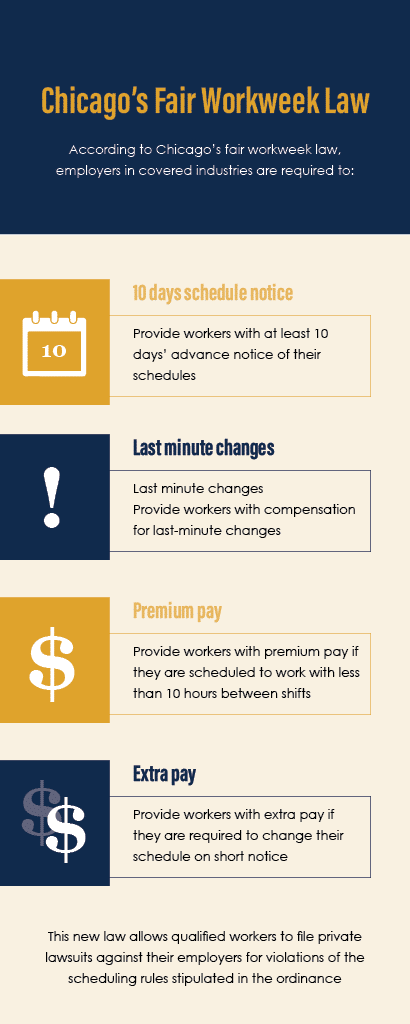
Chicago Overtime Infographic
Illinois Legal Requirements for Overtime
The overtime framework in Illinois draws heavily from federal standards established by the Fair Labor Standards Act while incorporating several state-specific provisions that Chicago workers should understand.
Under the Illinois Minimum Wage Law, employers must pay overtime at one and one-half times the regular hourly rate for every hour worked beyond 40 in a single workweek. The Illinois Department of Labor maintains enforcement authority over these provisions and accepts complaints from workers who believe their employers have committed wage violations.
Federal overtime regulations establish exemptions for certain executive, administrative, and professional employees who satisfy both salary requirements and specific duty tests outlined in Department of Labor guidance. The salary threshold currently sits at $684 per week, equivalent to $35,568 annually, and employees earning below this amount generally cannot be classified as exempt no matter what responsibilities their positions involve.
Time limits apply to all overtime claims regardless of how clear-cut the violation may appear. Federal law grants workers two years from the date of each violation to pursue recovery, though that window extends to three years when the employer acted willfully in denying proper compensation. Many employees who face wrongful termination after raising overtime concerns must balance multiple legal deadlines simultaneously when deciding how to proceed.
Important Aspects of a Chicago, IL Overtime Case
Building the Evidentiary Foundation
Overtime claims succeed or fail based largely on the evidence available to demonstrate hours actually worked versus hours compensated. Federal and state law both require employers to maintain accurate time records for non-exempt workers, but those records sometimes vanish, contain suspicious gaps, or reflect obvious manipulation. When employer records prove unreliable, workers can establish their hours through personal calendars, emails with timestamps, text message exchanges with supervisors, scheduling application data, and testimony from coworkers who witnessed the unpaid labor firsthand.
The Mathematics of Wage Recovery
Calculating the full value of an overtime claim requires attention to details that many workers overlook when estimating their losses. The regular rate used for overtime purposes must incorporate shift premiums, production bonuses, and other compensation beyond straight hourly wages. Federal law also permits recovery of liquidated damages in an amount equal to the unpaid wages themselves, effectively doubling the recovery when employers cannot demonstrate good faith compliance efforts. Illinois law provides additional remedies including penalties and fee-shifting that further increase the stakes for non-compliant employers.
Deciding Between Individual and Collective Pursuit
Overtime violations sometimes affect just one worker whose supervisor bent the rules, but more often they stem from company-wide policies that impact dozens or hundreds of employees simultaneously. When systematic violations exist, pursuing claims collectively through class or collective action procedures allows workers to pool resources, share litigation costs, and present a unified front that carries substantially more settlement leverage than isolated individual complaints. Whether your situation calls for individual or collective treatment depends on factors our attorneys analyze during initial consultations.
Anticipating the Defense Strategy
Employers rarely concede liability without mounting some form of defense, and certain arguments appear in overtime cases with predictable regularity. Companies frequently insist that contested workers qualified for exemption, that official time records accurately captured all hours worked, or that human resources staff reasonably relied on advice from outside consultants when designing compensation structures. While these defenses occasionally reduce damages, they seldom eliminate liability entirely once a genuine violation has occurred. Much of what workers hear about employment litigation overstates the difficulty of proving these cases and understates the protections available under current law.
Choosing the Right Forum
Workers with overtime claims can pursue recovery through administrative channels by filing complaints with the U.S. Department of Labor Wage and Hour Division or the Illinois Department of Labor, both of which have authority to investigate employers and seek penalties for violations they substantiate. The alternative path runs through state or federal court, where workers gain greater control over case strategy, faster timelines to resolution, and access to liquidated damages that administrative processes may not provide.
Acting Before Deadlines Expire
The right to recover unpaid overtime does not last forever, and each passing paycheck potentially moves older violations beyond the reach of legal action. Federal claims must generally be filed within two years of each violation, or three years when willful conduct extends the limitations period. Every week of delay costs workers the ability to recover wages from pay periods that slip past the relevant cutoff date. Those who delay filing risk permanently forfeiting compensation they would otherwise have recovered.
Contact Disparti Law Group
Workers throughout Chicago deserve full payment for every hour they spend on the job, and employers who withhold overtime wages cause real financial harm to families who depend on that income. If you believe your employer has failed to pay the overtime compensation you earned, Disparti Law Group offers free consultations to evaluate your situation and explain your options under state and federal law.
Our firm handles overtime cases on a contingency basis with no fees unless we recover compensation on your behalf. Reach out through our contact page to schedule a consultation with an overtime attorney in Chicago, IL who will listen to your concerns and provide honest guidance about the path forward.