






Employment Discrimination Lawyer Chicago, IL
If you have been treated unfairly at work because of your race, sex, age, disability, religion, or another protected characteristic, you may have legal options that could result in significant compensation for the harm you experienced. Workplace discrimination takes many forms, and employees who experience it often struggle to determine whether what happened actually violates the law.
Being passed over for a promotion, receiving a sudden negative performance review, or losing your job entirely feels wrong when you suspect the real reason relates to who you are rather than how you perform. Understanding when unfair treatment crosses the line into illegal discrimination requires knowledge of state and federal employment statutes that most workers have never had reason to study until they find themselves in this situation.
Disparti Law Group Accident & Injury Lawyers represents employees throughout Illinois who have experienced illegal discrimination in hiring, firing, promotion, compensation, and other employment decisions. Our Chicago, IL employment discrimination lawyer has spent years holding employers accountable when they violate workers’ civil rights, and we provide free consultations to employees who believe they have been treated unlawfully.
Why Choose Disparti Law Group Accident & Injury Lawyers for Employment Discrimination Cases in Chicago, IL?
Exposed to Employment Law From Every Angle
Larry Disparti founded Disparti Law Group Accident & Injury Lawyers on the principle that workers deserve aggressive representation against employers who violate their rights. He holds licenses to practice in Illinois, Florida, Arizona, and Washington, D.C., which provides him perspective on how employment discrimination laws function across different jurisdictions and regulatory frameworks.
Larry serves on the Board of Managers for the Illinois Trial Lawyers Association and maintains active membership in the National Employment Lawyers Association, the preeminent organization for attorneys who represent employees in workplace disputes. His credentials include membership in the Million Dollar Advocates Forum and the Multi-Million Dollar Advocates Forum, honors reserved for attorneys who have obtained verdicts and settlements exceeding those benchmarks for their clients. Larry completed his Juris Doctor at Stetson University College of Law following undergraduate studies at the University of South Florida.
Our employment lawyer in Chicago, IL has witnessed the full spectrum of discriminatory conduct that occurs in workplaces across the region. We have represented workers denied promotions because of their race, employees terminated after requesting disability accommodations, women paid less than male colleagues performing identical work, and older workers pushed out to make room for younger replacements. Each case reinforced our understanding that discrimination persists in workplaces of every size and industry throughout Chicago.
Results That Demonstrate Our Commitment
Disparti Law Group Accident & Injury Lawyers has recovered millions of dollars for employees whose employers violated their civil rights. Our employment discrimination results include a $450,000 recovery in a case where an employer treated our client unlawfully based on a protected characteristic. We also secured $900,000 for a client in a civil rights violation matter and have obtained $190,000 recoveries in additional discrimination lawsuits that required litigation to resolve.
★★★★★
“Disparti Law Group Accident & Injury Lawyers is amazing!! They are all very professional and informative while helping through a difficult time. I would highly recommend them to all my friends and family…” — SHANNON DOLAN
Read more reviews on our Google Business Profile.
Fighting Without Financial Risk to You
Employment discrimination cases pit individual workers against employers with substantial resources devoted to defending against liability. Companies retain experienced defense counsel, human resources professionals trained to document justifications for adverse actions, and insurance policies that fund protracted litigation campaigns designed to exhaust plaintiffs financially before trial. Disparti Law Group Accident & Injury Lawyers accepts employment discrimination cases on a contingency fee basis, which means you pay nothing unless we recover compensation through settlement or verdict.

Types of Employment Discrimination Cases We Handle in Chicago, IL
Federal and state laws prohibit discrimination based on numerous protected characteristics, and violations occur across every stage of the employment relationship from initial hiring through termination.
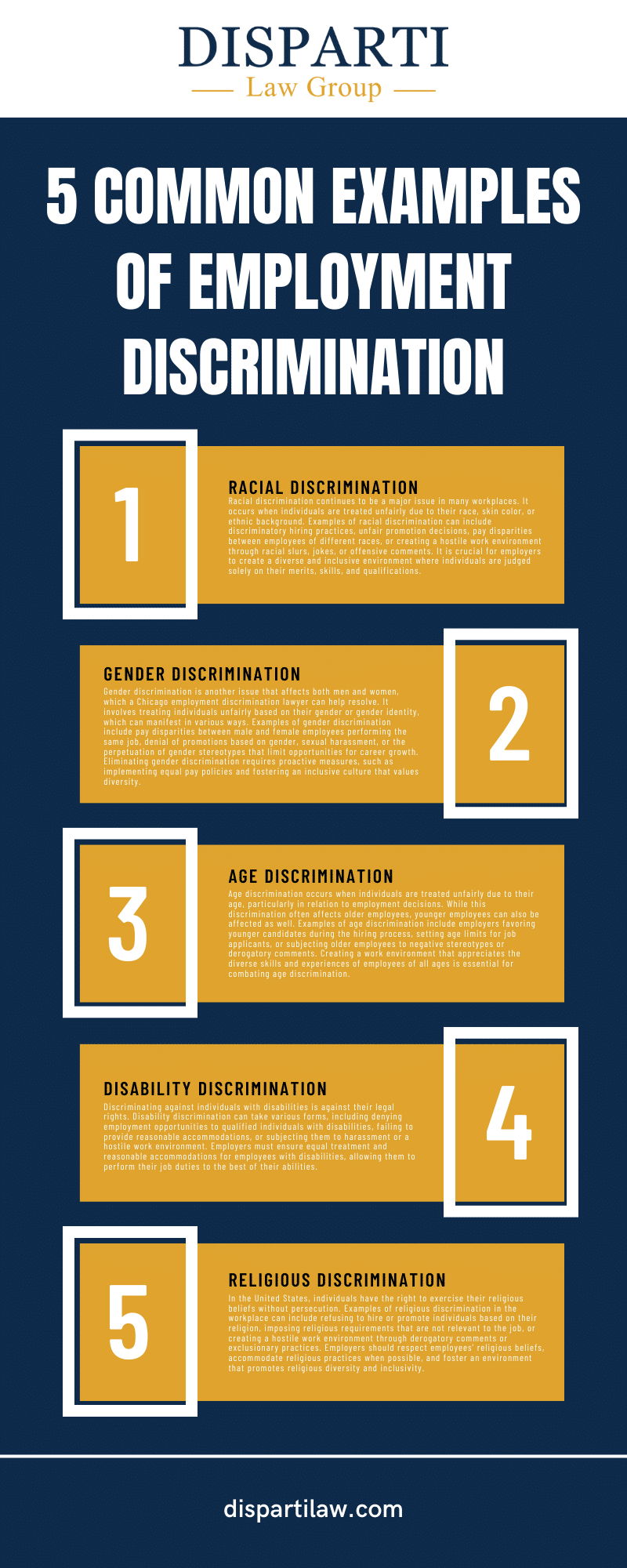
- Race and national origin discrimination. Employers who make hiring, firing, promotion, or compensation decisions based on an employee’s race, ethnicity, or country of origin violate both federal law and the Illinois Human Rights Act. These cases sometimes involve overt racist conduct but more often require proving that facially neutral policies disproportionately impact workers of certain backgrounds without legitimate business justification.
- Sex and gender discrimination. Women continue to face unequal treatment in workplaces throughout Chicago, including pay disparities for equivalent work, denial of promotions to leadership positions, pregnancy discrimination, and hostile work environments created by unwelcome sexual conduct. Illinois law extends protection beyond federal requirements to cover sexual orientation and gender identity discrimination that some federal courts have been slower to recognize.
- Age discrimination. The Age Discrimination in Employment Act protects workers 40 and older from adverse employment actions motivated by their age. Employers sometimes mask age discrimination behind layoffs that disproportionately impact older workers, performance improvement plans designed to create paper trails justifying termination, or job postings seeking candidates with characteristics associated with younger applicants.
- Disability discrimination. The Americans with Disabilities Act requires employers to provide reasonable accommodations enabling qualified individuals with disabilities to perform essential job functions. Discrimination occurs when employers refuse accommodation requests without engaging in the required interactive process, terminate employees after learning of disabilities, or construct job requirements that unnecessarily exclude people with certain conditions.
- Religious discrimination. Employers must reasonably accommodate sincerely held religious beliefs unless doing so would impose undue hardship on business operations. Workers who face discipline for religious dress or grooming practices, denial of schedule adjustments for religious observances, or hostile treatment based on their faith may have viable discrimination claims under state and federal law.
- Retaliation for protected activity. Employees who report discrimination, participate in investigations, or oppose unlawful practices enjoy protection against employer retaliation. Our firm handles workplace retaliation claims on behalf of workers who faced termination, demotion, or other adverse consequences after exercising their legal rights.
Chicago Employment Discrimination Infographic
Illinois Legal Requirements for Employment Discrimination Claims
Illinois maintains one of the most protective employment discrimination frameworks in the nation through the Illinois Human Rights Act, which covers employers with as few as one employee for certain claims. This stands in contrast to federal laws like Title VII of the Civil Rights Act, which only applies to employers with 15 or more workers, leaving employees of small businesses without federal recourse in many situations.
The Illinois Department of Human Rights investigates discrimination charges filed by workers who believe their employers violated state law. Employees must typically file charges with this agency or the Equal Employment Opportunity Commission before pursuing lawsuits in court, though worksharing agreements between the agencies often allow a single filing to satisfy both requirements.
Protected classes under Illinois law extend beyond federal categories to include sexual orientation, gender identity, military status, unfavorable military discharge, citizenship status, and order of protection status. These expanded protections mean that workers who might lack federal claims often retain state law remedies that provide equivalent or superior relief.
Timing requirements apply to all discrimination claims regardless of how obvious the violation may appear. Workers generally have 300 days from the discriminatory act to file charges with the EEOC when state agency worksharing applies, and separate deadlines govern Illinois Human Rights Act claims. Some workers who experience discrimination also face wrongful termination when employers decide to eliminate them rather than address the underlying problems, which creates multiple overlapping claims requiring strategic coordination.
Important Aspects of a Chicago, IL Employment Discrimination Case
Recognizing Discrimination When It Occurs
Many employees struggle to identify discrimination because employers rarely announce discriminatory motivations openly. Instead, discrimination manifests through patterns that become visible only when examined carefully over time. A qualified employee passed over for multiple promotions while less experienced colleagues advance, performance evaluations that decline shortly after an employer learns of a disability or pregnancy, comments about age or cultural background that precede adverse actions—these patterns often reveal discriminatory intent that direct evidence would never capture.
Documenting Your Experience
Evidence wins employment discrimination cases, and workers should begin documenting concerning conduct as soon as they notice it occurring. Contemporaneous notes describing specific incidents carry significant weight because they demonstrate what the employee observed and understood at the time events unfolded. Emails, text messages, performance reviews, witness observations, and recordings where legally permitted all contribute to building a record that supports legal claims.
The Administrative Process
Most employment discrimination claims must proceed through administrative channels before reaching court. Filing a charge with the EEOC or Illinois Department of Human Rights initiates an investigation that may result in agency findings, mediation opportunities, or issuance of a right-to-sue letter authorizing court action. Navigating this process correctly preserves your legal options while occasionally achieving resolution without the expense and uncertainty of litigation.
Damages Available to Discrimination Victims
Workers who prove employment discrimination can recover multiple categories of damages depending on the specific laws violated and the conduct involved. Back pay compensates for wages lost due to discriminatory termination or failure to promote. Front pay addresses ongoing wage losses when reinstatement proves impractical. Compensatory damages cover emotional distress and other non-economic harms. Punitive damages punish particularly egregious conduct and deter future violations.
Employer Defenses and How We Counter Them
Employers accused of discrimination typically assert that their decisions rested on legitimate, non-discriminatory reasons unrelated to protected characteristics. They point to performance deficiencies, policy violations, restructuring decisions, and subjective assessments of workplace fit to justify adverse actions. Defeating these defenses requires demonstrating that proffered reasons are pretextual which is offered to conceal the true discriminatory motivation rather than reflecting honest business judgment. We examine comparator treatment, timing, shifting explanations, and statistical patterns to expose discrimination that employers attempt to disguise. Much of what workers believe about employment litigation overstates the obstacles they actually face when pursuing valid claims.
Contact Disparti Law Group Accident & Injury Lawyers
Every worker deserves a workplace free from discrimination based on characteristics that have nothing to do with job performance. When employers violate that principle, they cause real harm to employees and their families while undermining the fundamental fairness that Illinois and federal law demand.
Disparti Law Group Accident & Injury Lawyers provides free consultations to workers who believe they have experienced illegal employment discrimination in Chicago. Our firm handles these cases on a contingency basis, collecting fees only when we recover compensation on your behalf. Contact us through our consultation request form to discuss your situation with an employment discrimination attorney in Chicago, IL who will evaluate your claims and explain your options.